PBIS Information
What is PBIS?
Positive Behaviors Interventions and Supports (PBIS) is a school-wide program that emphasizes on school-wide systems of support that include
proactive strategies for defining, teaching and supporting appropriate student behaviors to create positive school environments. PBIS is not a curriculum, intervention or practice, but rather a framework or approach for assisting school personnel in adoption and organizing evidence-based behavioral interventions into an integrated continuum that enhances academic and social behavior outcome for all students.
PBIS emphasizes four integrated elements:
1. Data for decision-making
2. Measurable outcomes supported and evaluated by data
3. Practices with evidence that these outcomes are achievable
4. Systems that efficiently and effectively support implementations of these practices
PBIS (Positive Behavioral Interventions and Supports) is an organized, data-driven system of interventions, strategies, and supports that positively impact school-wide and individual behavior planning.
Using the most current best practices, strategic teams are trained to positively impact behavior at three key behavioral tiers: Universal or primary (whole school); Secondary (individual child or group of at-risk children); and Tertiary or Intensive (children with complex needs and behaviors that severely impact the child, school and/or community functioning).
Why is it so important to focus on teaching positive school behaviors?
Frequently, the question is asked, “Why should I have to teach kids to be good? They already know what they are supposed to do. Why can I not just expect good behavior?” In the infamous words of a TV personality, “How is it working out for you?”
In the past, school-wide discipline has focused mainly on reacting to specific student misbehavior by implementing punishment-based strategies including reprimands, loss of privileges, offices referrals, suspensions, and expulsions. Research has shown that the implementation of punishment, especially when used inconsistently and in the absence of other positive strategies, is ineffective. Introducing, modeling, and reinforcing positive social behavior is an important step of a student’s educational experience. Teaching behavioral expectations and rewarding students for following them is a much more positive approach
than waiting for misbehavior to occur before responding. The purpose of school-wide PBIS is to establish a climate in which appropriate behavior is
the norm.
What is a systems approach in school-wide PBIS?
An organization is a group of individuals who behave together to achieve a common goal. Systems are needed to support the collective use of best practices by individuals within the organization. The school-wide PBIS process emphasizes the creation of systems that support the adoption anddurable implementation of evidence-based practices and procedures, and
fit within on-going school reform efforts. An interactive approach that includes opportunities to correct and improve four key elements is used in school-wide PBIS focusing on: 1) Outcomes, 2) Data, 3) Practices, and 4)
Systems.
What does this mean for parents?
Acknowledge and recognize your child’s following of school-wide expectations.
When your child receives Jaguar Jaks, ask them why they received it and acknowledge them for following school-wide expectations.
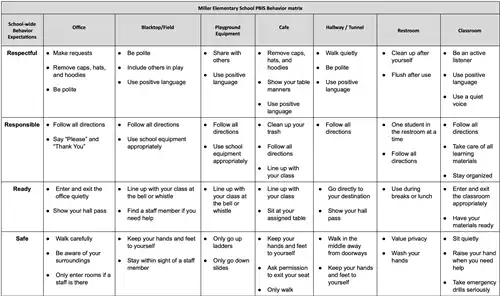
Review the four school-wide expectations with your child: Respectful, Responsible, Ready and Safe and remind them how important they are to follow.
Remind them to inform an adult if they are being bothered by another student inside and outside the classroom.
Miller's Behavior Flow Chart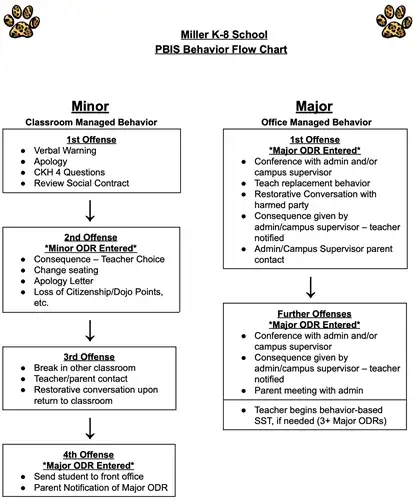
Miller's Positive Behavior Matrix